Dagnul, intake software for Drug Safety, reads other teams' inboxes as items reach it.
Trained on pharmacists' labels, then your corrections, the model finds the four criteria and proposes seriousness and day zero for a scientist to confirm. The clock starts in whichever team first holds the case.
Get the count
Adverse-event intake for Drug Safety from streams other teams run
- Medical information inbox
- Call-center log
- Brand social pages
- Market-research AE forms
Day zero is the first day anyone at the company, or working for it, holds the four criteria. Weekends and holidays count.
6 days
median from day zero to Drug Safety's receipt
Example quarter: 21 serious, unexpected cases from other teams reached Drug Safety a median of 6 days after day zero. Rushing the 9 days left buys none back.
Count yours: first record outside Drug Safety to receipt date, case by case. Items land in the queue, marked by the model, within 30 minutes of reaching Dagnul.
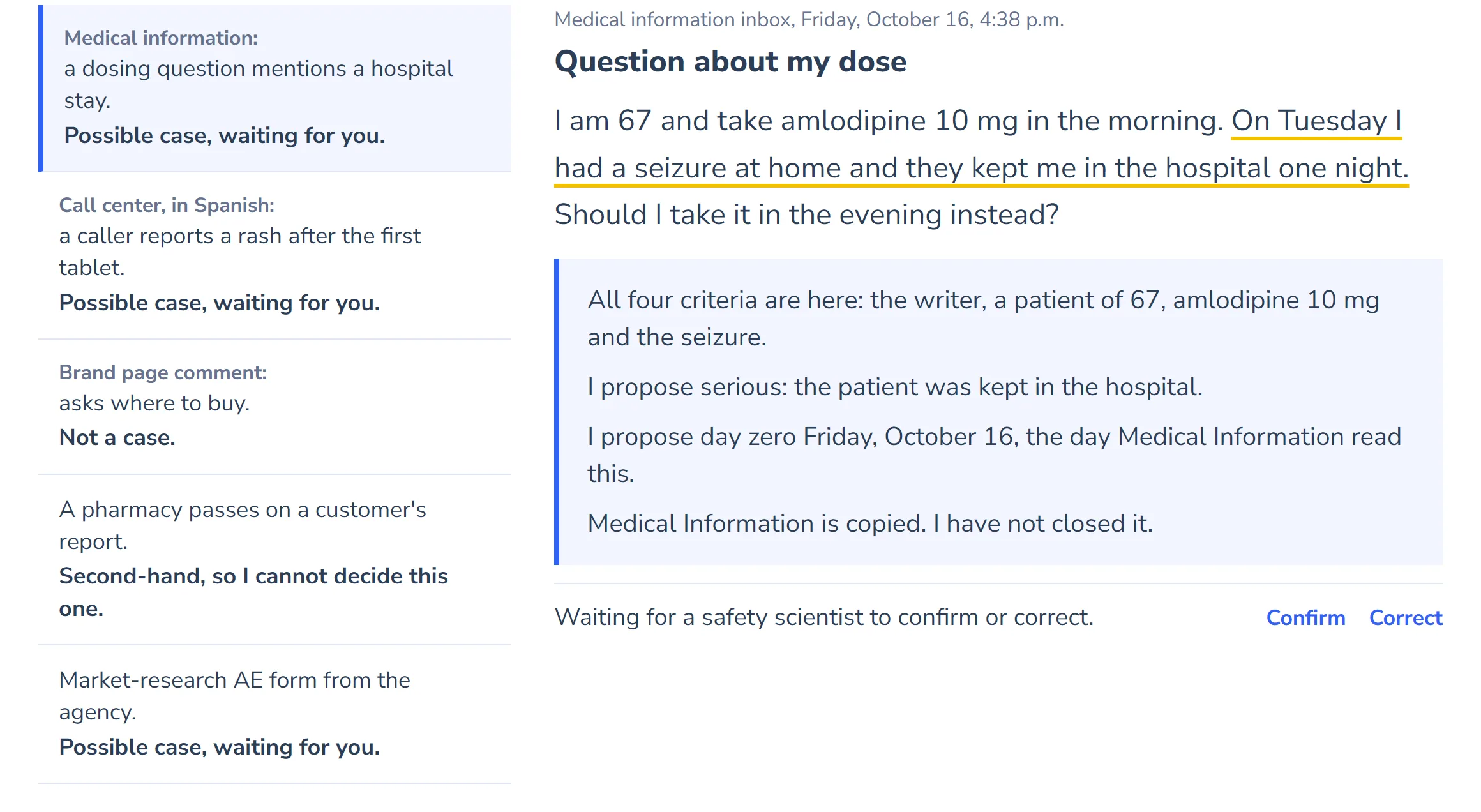
A dosing question to Medical Information mentions a seizure and a night in the hospital: a serious, unexpected case, day zero Friday.
An example item from the medical-information inbox. Each mark quotes its sentence and stays a proposal until a safety scientist confirms it.
Friday's message
The note writes no free text of its own.
Second-hand
A pharmacy's relayed report: 'I cannot decide this one'.
The line
Your scientists set one per stream, low, so the queue gets too many items rather than too few. Your head of pharmacovigilance signs every move.
Friday, 4:38 p.m.: a patient's dosing question reaches Medical Information. At 4:41 the model finds all four criteria and proposes serious, with Friday as day zero.
Monday, 9:12 a.m.: a safety scientist confirms serious and, finding no seizure in the amlodipine labeling, unexpected. Its 15-day Alert report is due Saturday, October 31.
Dagnul's model closes no item. One closed by mistake would be a case nobody ever counts.
FDA's draft guidance on AI rates a model's risk by its influence on a decision and that decision's consequence. Here a scientist decides, and your written procedures can describe Dagnul as a system that proposes and routes.
A scientist sees a miss by the model within one working day.
Replies
None. Each stream's owning team answers under its own SOP.
Causality and expectedness
The model judges neither and leaves judgment calls undecided. A scientist checks your current labeling: an unlisted serious case is a 15-day Alert report.
DME list
A rule over MedDRA terms checks each reaction against FDA's Designated Medical Events list. The model's candidate terms are for that check only.
Safety database
Confirmed items only. Dagnul submits nothing to FDA.
With the model off
Items still reach the queue within 30 minutes, marked unread. The previous version can be switched back on for 90 days.
$890 a month for one intake stream, $1,990 for three, $2,990 for every stream you run.
Priced by the streams the model reads, whatever the items, cases or seats, so a quiet stream costs what a busy one does. A drug safety associate in Boston, most paid $72,000 to $103,000 a year, buys a Monday read of last week's logs.
One stream
$890 per month
We want to start with one stream
For a team starting with the stream where most of its late cases began, often the medical-information inbox.
- One intake stream, read as each item arrives
- Criteria, seriousness and day zero proposed, each with its sentence
- Every Drug Safety seat; the owning team copied on each item
- Item trail kept for ten years
Three streams
$1,990 per month
Two or three streams outside Drug Safety
For the usual set outside Drug Safety: medical information, the call-center contractor and one agency's AE forms.
- Three intake streams, each with its own line
- Corrections kept for retraining under the plan your head of pharmacovigilance approves
- A silence alert when a stream stops sending
- Item trail kept for ten years
Every stream
$2,990 per month
Four or more streams
For every stream the company runs, brand pages, patient support and rep call notes included, with no cap on their number.
- Every intake stream the company runs, no cap
- Each stream's line and test report in the validation package
- Every trail exported each quarter as PDF/A and CSV
- One supplier audit a year by your Quality team
- Connecting each stream: one copy rule or read-only connection, no data scientist
- The validation package, and a test report for each model version
- Retraining runs under the change control plan your head of pharmacovigilance approves
- Every Drug Safety seat, and a copy to each stream's owning team
- A read-only archive of every trail for ten years after you leave
The first stream runs six weeks beside your current reconciliation before any invoice. If your head of pharmacovigilance does not sign it live, you owe nothing.
Where it stands
Open to the Drug Safety teams of NDA, ANDA and BLA holders in the United States.
Where it runs
Every item is kept and processed in N. Virginia, and none goes to another company's model.
What it reads
The model reads English and Spanish text; text in other languages, call recordings and images reach a person unread.
Part 11 asks for time-stamped trails that never hide an earlier entry. Each item carries one.
The streams page your head of pharmacovigilance keeps, one correction and one item's trail, with the example company's items.
The model marks Saturday's brand-page comment not a case. On Monday a scientist corrects it: the post it sits under names the product.
That mistake can repeat until the next retraining your head of pharmacovigilance signs, up to a month later. Trails keep every date for ten years.


Where reports already reach the safety mailbox first, Dagnul has little to count.
The first thing you get is the count on your own last quarter. The one pictured is an example.
The model reads only streams your head of pharmacovigilance switches on. Its daily 'not a case' list runs long on brand pages, and a scientist confirms every line.
Dagnul is hosted software for intake alone. If patient text must stay on your servers, or experts want models for complaints, a platform you install does better.
- Heads of pharmacovigilance whose serious cases start in medical information, call centers, brand pages or agencies
- Teams who can name the owner of every stream
- Teams whose reports already land first in the safety mailbox
- Case processors wanting a faster safety database, MedDRA coding or E2B submission

Your last quarter, counted: the days before Drug Safety knew.
The model's first read is your last quarter, on the streams you name. Your scientists confirm each day zero, then we count the median days to Drug Safety's receipt, stream by stream.
Bring last quarter's count of 15-day Alert reports sent after day 15.
Free; only the data processing agreement comes first.
Slowest step: Commercial signs a letter for the contractor's and agency's exports.